
There’s a version of your budget where you save an extra $300, $500, or even $800 in a single month without getting a raise, without a side hustle, and without changing your income at all.
That version exists. And the 30-day no-spend challenge is how you get there.
The concept is simple: for 30 days, you spend money only on genuine necessities. No shopping. No dining out. No impulse buying. No subscriptions you don’t actually need. Just your core expenses and everything else stays in your account.
Most people who try this discover two things. First, they save significantly more than they expected. Second, they realize how much of their regular spending was completely automatic driven by boredom, habit, or impulse rather than actual need.
This guide gives you the complete 30-day no-spend challenge rules, a free printable tracker to keep you on track, and everything you need to actually finish the month.
What Is a No-Spend Challenge?
A no-spend challenge is a defined period a week, a month, or longer where you commit to spending money only on absolute necessities and pause all non-essential purchases.
It’s not about deprivation. It’s about pressing pause on autopilot spending long enough to see it clearly. Impulse sale notifications, one-click purchases, casual takeout orders these are the things a no-spend challenge interrupts. And interrupting them for 30 days changes how you relate to spending in a way that sticks long after the challenge ends.
A no-spend month is one of the fastest ways to money save without changing a single thing about your income. It works by stopping the outflow not by increasing the inflow.
Why Do a 30-Day No-Spend Challenge?
Before we get to the rules and there are specific rules that make this work it’s worth understanding what you’re actually getting out of 30 days of not spending.
You’ll save real money fast. Most people save $200–$600 during a no-spend month depending on their current habits. Some save more. It’s one of the most effective ways to help me save money in a short period.
You’ll identify exactly where your money leaks. After 30 days of not spending on non-essentials, you’ll know precisely which categories were quietly draining your budget. That awareness is worth more than the savings alone.
You’ll break impulse buying habits. Impulse buying is one of the biggest budget killers most people never consciously address. A no-spend challenge forces you to pause before every purchase and that pause becomes a habit that outlasts the challenge.
You’ll reset your relationship with money. After 30 days, things you used to buy without thinking start to look different. You evaluate purchases more carefully. You spend more intentionally. The reset is real and it lasts.
You’ll have a lump sum to redirect. Whatever you save during the challenge can become the foundation of your emergency fund, your first debt payment, or the beginning of your best saving plan for the rest of the year.
The 30-Day No-Spend Challenge Rules
These are the rules that make the challenge work. Without clear boundaries, a no-spend challenge becomes vague and easy to abandon. With them, you always know exactly whether a purchase is allowed or not.

Rule 1: Define Your Allowed Expenses Before Day One
The most important step happens before the challenge starts. Write down every expense that is allowed during the 30 days. These are your non-negotiables the things your life genuinely cannot function without.
Allowed expenses typically include: rent or mortgage, utilities, groceries (basics only), transportation to work, medications and medical needs, minimum debt payments, childcare, and pet food.
Everything not on this list is off-limits for the month. The specificity is what makes the rule work. Vague rules create loopholes. A written list does not.
Rule 2: No Dining Out: Zero Exceptions
Dining out is the most common way people quietly spend hundreds of dollars a month without realizing it. During the no-spend challenge, all meals come from home. No restaurants, no takeout, no coffee shops, no drive-throughs.
This single rule typically frees up $150–$300 for most households. Cook ahead, batch meals on weekends, and keep easy options available for the evenings when cooking feels hard. The impulse to order delivery is strongest when you’re tired and there’s nothing ready preparation is how you win that battle.

Rule 3: No Online Shopping
Online shopping is the modern version of impulse buying and the easiest one to fall into. One-click purchases, limited-time sales, “impulse sale” notifications all of it is designed to bypass your considered judgment.
For 30 days, close the shopping apps. Unsubscribe from promotional emails from every retailer. Remove saved card details from shopping sites if necessary. If you feel the urge to buy something online, write it down and revisit it in 30 days. Most of the time you’ll find you don’t want it anymore.
Rule 4: Cancel or Pause Non-Essential Subscriptions
Before the challenge begins, go through every subscription you’re paying for and cancel or pause anything non-essential. Streaming services beyond one, beauty boxes, food delivery memberships, app subscriptions you barely use pause them all for the month.
This is different from canceling them permanently (though some you may choose not to restart). It’s a 30-day pause that shows you exactly which subscriptions you actually miss and which ones you don’t.
Rule 5: Use Cash or Debit Only: No Credit Cards

For the duration of the challenge, leave the credit cards at home. Credit cards create psychological distance from spending swiping doesn’t feel like real money leaving your account the way cash does.
Using cash or debit keeps spending visible and concrete. When the money is gone from your account in real time, every purchase feels more deliberate. That feeling is exactly what you’re trying to build.
Rule 6: Meal Plan Every Week
A weekly meal plan is what makes the no-dining-out rule sustainable. Without a plan, you’ll hit Thursday evening with nothing prepped, no energy to cook, and a strong temptation to order something. With a plan, Thursday has a designated meal that’s already been shopped for.
Spend 15 minutes on Sunday planning the week’s meals and building your grocery list from that plan. Stick to the list at the store. This one habit saves money, reduces food waste, and makes the challenge significantly more manageable.
Rule 7: Find Free Alternatives for Everything
The challenge isn’t to be bored for 30 days it’s to find that entertainment, connection, and enjoyment don’t require spending money. This is one of the most surprising discoveries most people make.
Free alternatives exist for almost everything: the library for books and movies, free community events, parks and trails, cooking new recipes at home, calling friends instead of going out, board games, free streaming services like Tubi or Pluto TV. The month becomes an exercise in creativity that most people genuinely enjoy more than they expected.
Rule 8: Track Every Day
Daily tracking is what keeps the challenge from drifting. Use the free printable at the end of this guide to check off each day and note any spending that occurred. If you had a slip-up, write it down honestly. If you held firm, mark it as a win.
The visual progress of a filled-in tracker is genuinely motivating. By week three, looking at 20 consecutive days checked off makes you unwilling to break the streak.
Rule 9: Tell Someone Who Will Hold You Accountable
Tell one person a partner, a friend, a family member that you’re doing the challenge. Ask them to check in on you weekly. The accountability changes the dynamic significantly. It’s much harder to rationalize a takeout order when you know someone’s going to ask how the challenge is going.
Even better: find someone who will do the challenge with you. The combination of shared experience and friendly accountability is what gets most people through the harder days.
Rule 10: Have a Plan for Slip-Ups
You will have at least one moment during the 30 days where you spend on something that wasn’t on the allowed list. A forgotten subscription charge, a genuine moment of weakness, an unexpected situation. Plan for this now so it doesn’t become the reason you quit.
The rule is simple: acknowledge it, record it, and continue. One slip-up doesn’t cancel 29 days of discipline. The people who finish the challenge are not the ones who are perfect they’re the ones who don’t let imperfection become an excuse to stop.
Free 30-Day No-Spend Challenge Printable
Use this tracker to check off each day and stay accountable. Print it out and put it somewhere visible on your fridge, your desk, or your bathroom mirror.
Day tracker: 30 boxes, one for each day. Check each day you successfully stayed within your allowed expenses.
Weekly check-ins: Space to note how much you saved each week and how you’re feeling about the challenge.
Slip-up log: A dedicated space to record any unplanned spending honestly not to punish yourself, but to learn from it.
End of month reflection: What did you save? What surprised you? Which habits are you keeping?
How to Download the Free 30-Day No-Spend Challenge Printable
Step 1:
Scroll down to the button in this article and click “Click Here to Download Free Printable”
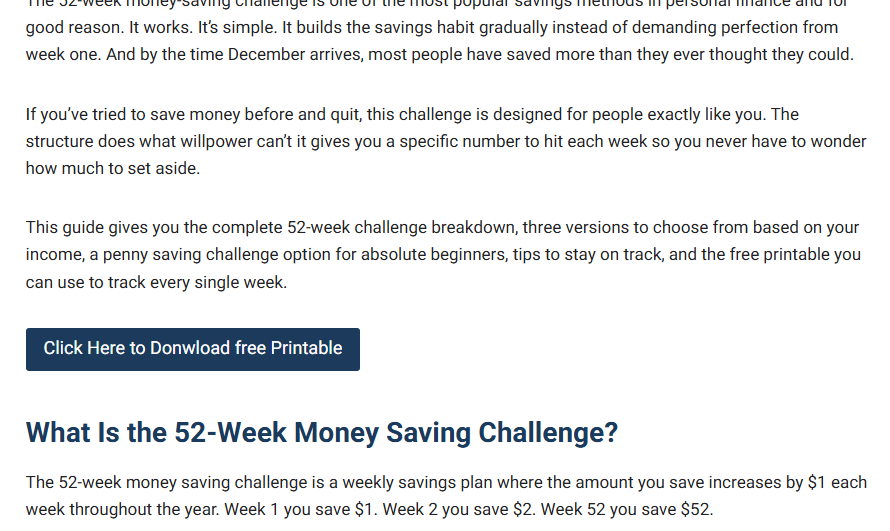
Step 2:
A new page will open showing the printable tracker. Click the “Download / Print Tracker”
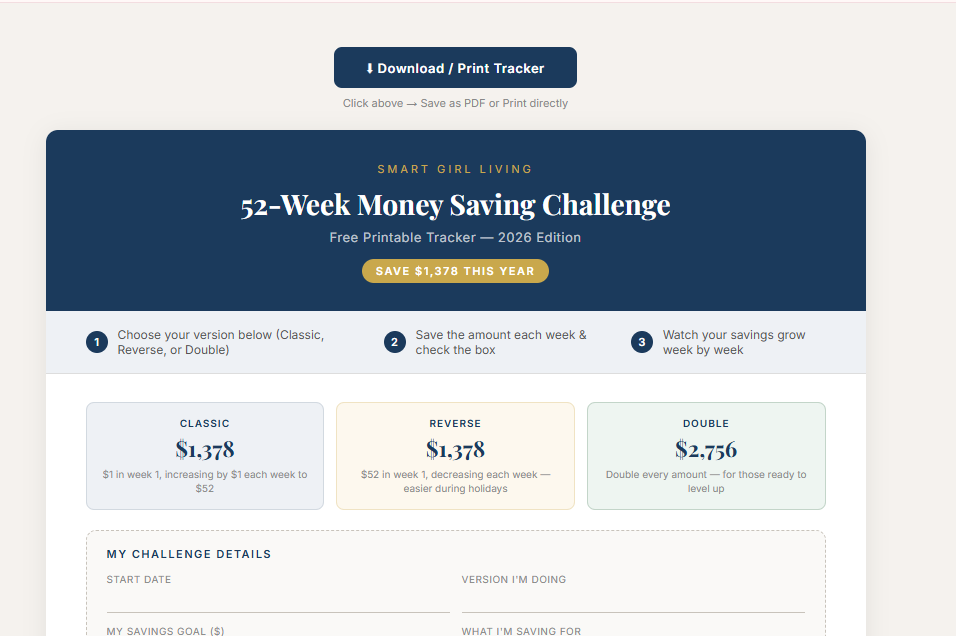
Step 3:
Your browser’s print window will open. Make sure Destination is set to “Microsoft Print to PDF” and Color is set to “Color”. Then click Print.
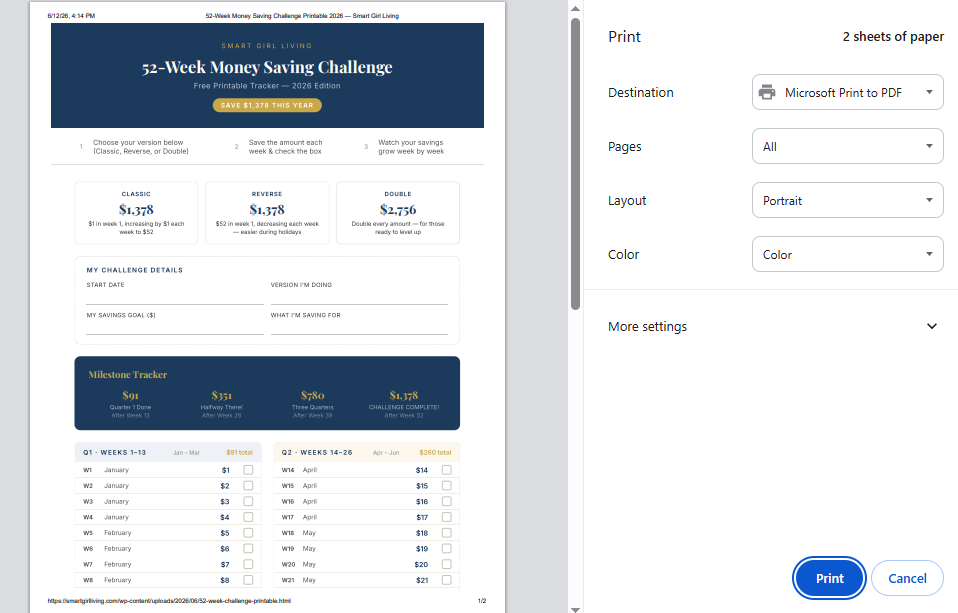
Step 4:
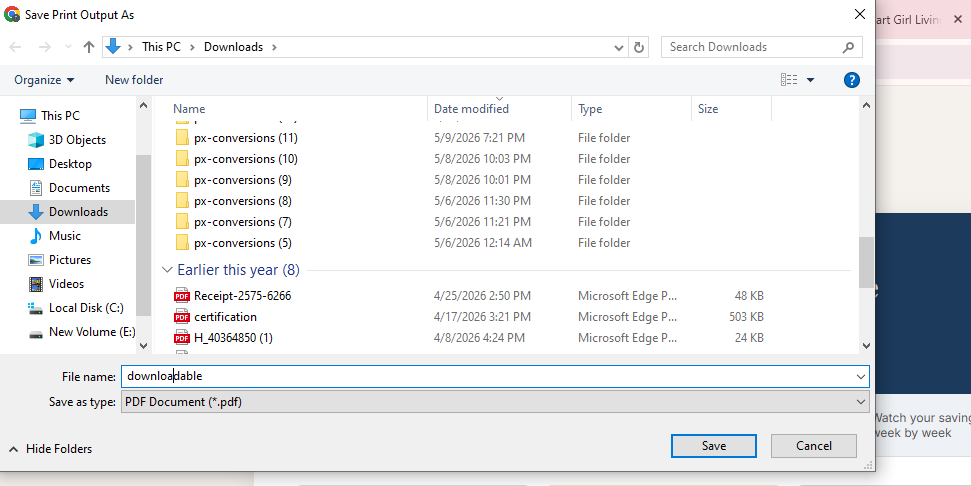
A save dialog will open. Choose your folder, name the file (example: “52-week-challenge-printable”), and click Save. Your PDF is now saved to your computer, ready to print!
How to Track Your Spending During the Challenge
Tracking spending doesn’t have to be complicated. The simplest system works best:
Keep a small notebook or use your phone’s notes app. Every time you spend money on anything write it down immediately. At the end of each day, review the list and check whether everything was on your allowed expenses list.
If you prefer an app, a monthly budget app like Mint, YNAB, or EveryDollar makes tracking automatic. These best saving apps connect to your bank account and categorize every transaction in real time so you can see exactly how the challenge is going without manual entry. They also make it easy to spot any subscriptions or charges you forgot about that need to be paused.
The combination of a printed daily tracker and a digital monthly budget app is the most effective approach for most people one gives you the visual satisfaction of checking off days, the other catches everything automatically.
What to Do With the Money You Save
This is the question that determines whether the no-spend challenge actually changes your finances long-term or just gives you a one-month bump that disappears by February.
Before the challenge starts, decide exactly where the money you save is going. Name it specifically.
Option 1: Emergency fund. If you don’t have $1,000 set aside for unexpected expenses, this is where the savings go first. An emergency fund is the foundation of any best saving plan without it, one bad month puts you right back where you started.
Option 2: Debt payoff. If you’re carrying credit card debt or a personal loan, directing your no-spend savings toward a lump-sum payment accelerates your payoff timeline significantly.
Option 3: A specific savings goal. House down payment, vacation fund, car fund whatever your next financial goal is, the no-spend savings become the seed money.
Option 4: Start building toward a saving investment plan. Once your emergency fund is in place and high-priority debt is handled, the money you freed up during the challenge can become the beginning of a longer-term financial plan. Many people use the momentum from a successful no-spend month to open a savings account and start contributing regularly which is often the best plan to invest money for beginners who are just getting started.
Whatever you choose, the key is to decide before Day 1 and move the money immediately when the month ends before lifestyle spending has a chance to absorb it.
How to Stay Motivated for 30 Days

The hardest days of the challenge are days 8–14. The initial motivation has worn off, and you’re not close enough to the finish line to feel the pull of the ending. This is where most people slip.
A few things that reliably help:
Check your running savings total every few days. Seeing real numbers build is motivating in a way that abstract commitment isn’t.
Use the free printable tracker every single day. The visual streak of checked boxes creates a “don’t break the chain” effect that keeps you going through the middle weeks.
Remind yourself of what the money is for. The emergency fund, the debt payment, the savings goal whatever you named it on Day 1. That purpose is what gets people through Day 11 when the temptation to order dinner is strongest.
What to Expect After the Challenge

Most people report that after 30 days, their relationship with spending is genuinely different. Things they used to buy automatically now get evaluated. Impulse buying urges are noticed rather than acted on. The default answer to “should I buy this?” changes from yes to maybe.
These changes don’t require ongoing effort to maintain they happen naturally from 30 days of building new patterns. The no-spend month creates the habit and the habit does the work after that.
Many people also find that they want to keep some of the rules permanently. The meal planning habit often stays. The subscription audit becomes quarterly. The impulse purchase pause becomes the new default.
If you want to continue building on this momentum, combining the no-spend challenge with a consistent budgeting practice is the most effective next step. My guide on how to make a budget for beginners shows you exactly how to build a budget that keeps the savings going long after the challenge ends.
And if you want to take on another savings challenge after this one, the 52-week money saving challenge builds on the habits you’ve just formed and saves you $1,378 over the next year.
Final Thoughts on the 30-Day No-Spend Challenge

Thirty days. That’s all it takes to save hundreds of dollars, break habits you didn’t know you had, and fundamentally change how you think about spending.
The rules exist to make the challenge doable not to make it miserable. Clear boundaries, daily tracking, a free printable, and a specific plan for the money you save are what turn a good idea into a real result.
Print the tracker. Write your allowed expenses list. Tell someone. Start Monday.
If you’re looking for even more ways to save money alongside this challenge, my guide on how to save money fast on a tight budget has 20 specific strategies you can layer in during your no-spend month many of which work perfectly alongside the challenge rules.
And when the 30 days are done and you’re looking at your savings, my guide on how to take control of your finances shows you exactly what to do with the momentum you’ve built.