
Most people have financial wishes. Very few have financial goals.
The difference isn’t ambition. It’s structure. A wish is “I want to save more money.” A goal is “I want to save $5,000 for an emergency fund by December, and I’m going to automate $416 a month starting now to get there.”
The first one feels good to think about. The second one actually happens.

This guide gives you a complete framework for setting financial goals that stick not just inspiration to save, but a specific structure that turns vague money desires into real, trackable targets. There’s also a free printable goal worksheet at the end so you can write yours down the moment you finish reading.
Why Most Financial Goals Fail Before They Start
Setting a goal and having it fail isn’t a discipline problem. It’s usually a design problem.
Financial goals fail for three predictable reasons:
They’re vague. “Save more” and “pay off debt” are intentions, not goals. Without a specific number and a specific date, there’s no way to measure whether you’re on track and what can’t be measured can’t be managed.
They’re disconnected from a plan. Writing down “save $10,000 this year” without a monthly savings number, a budget that makes room for it, and an account to put it in is still just a wish. The goal needs a mechanism.
They’re not reviewed. Setting goals in January and checking them in December skips eleven months of feedback and course-correction. Most goals that get reviewed monthly get achieved. Most that don’t, don’t.
The framework below addresses all three.
The Financial Goals Framework: 6 Steps That Actually Work
Step 1: Start With Your Why, Not Your What

Before you write a single goal, spend five minutes on this question: what would your life look like if money wasn’t a source of stress?
This isn’t a visualization exercise. It’s practical. The answer tells you what your goals are actually in service of and goals anchored to something meaningful are significantly more likely to be maintained through the months when motivation dips.
Common answers: being able to handle any emergency without panic, having the option to work less, owning a home, being debt-free before 40, retiring without financial dependence on anyone.
Write your answer down. It becomes the reason you keep going when the goal feels far away.
Step 2: Categorize Goals by Time Horizon

Financial goals exist at three different time scales, and each needs different treatment:
Short-term goals (under 1 year): These need to be funded monthly from your current income. They require a budget adjustment to make room.
Examples: building a $1,000 emergency fund, paying off your smallest credit card, saving for Christmas expenses, saving for a specific purchase.
Medium-term goals (1–5 years): These require consistent monthly contributions and usually a dedicated savings account or sinking fund.
Examples: saving for a house down payment, paying off all credit card debt, saving $10,000, building a 3–6 month emergency fund, saving for a car.
Long-term goals (5+ years): These require the most patience and the most consistent habits. They often involve retirement savings or significant life milestones.
Examples: paying off a mortgage early, building retirement savings, funding a child’s education, achieving full financial independence.
Write down at least one goal in each category. Most people focus only on long-term aspirations (retirement) and short-term survival (this month’s bills), skipping the medium-term goals where most meaningful financial progress actually happens.
Step 3: Apply the SMART Goal Framework to Each Goal

This is where vague intentions become real financial goals. For each goal you want to set, answer these five questions:
Specific: What exactly am I saving for or paying off? Not “save money”; “save for a 20% down payment on a home.”
Measurable: What is the exact dollar amount? “$35,000 for a down payment on a $175,000 home.”
Achievable: Is this realistic given my current income and expenses? Not “can I do this in a perfect scenario” but “can I do this in my real life right now?”
Relevant: Does this goal align with my actual priorities, or am I setting it because I think I should? A goal that doesn’t connect to something you genuinely care about won’t survive month four.
Time-bound: What is the specific deadline? “By September 2027” not “in a few years.”
The SMART goal version of a financial goal looks like this:
Vague version: “I want to save for a house.” SMART version: “I will save $35,000 for a house down payment by December 2027 by automating $972 per month to a dedicated savings account, funded by reducing dining out spending by $200/month and directing my tax refund each year.”
That second version is a plan. The first is still a wish.
Step 4: Work Backward to a Monthly Number

Every financial goal needs to translate to a specific monthly action otherwise it lives in a journal and nowhere else.
The formula:
Total amount needed ÷ Number of months until deadline = Monthly contribution required
Examples:
$1,000 emergency fund in 10 months = $100/month $5,000 vacation fund in 18 months = $278/month $20,000 debt cleared in 36 months = $556/month (extra above minimums) $35,000 down payment in 36 months = $972/month
Now look at your budget. Does your income minus your current expenses leave room for this monthly amount? If yes set up automation and you’re done. If no either adjust the timeline (extend the deadline and reduce the monthly number), find spending to cut, or find additional income to close the gap.
Working backward makes the goal concrete. It stops being abstract and starts being a line item.
Step 5: Set Up the System Before You Need the Willpower
The biggest mistake in financial goal-setting is relying on willpower to execute. Willpower is unreliable. Systems are not.
For every financial goal with a monthly contribution:
Open a dedicated account. Give it the name of the goal “House Fund,” “Emergency Fund,” “Christmas.” The label matters psychologically. People are significantly less likely to raid an account named “Emergency Fund” than one named “Savings.”
Automate the transfer. Set up an automatic payment from your checking account on the day your paycheck lands not at the end of the month. The goal contribution should move before discretionary spending happens.
Set a monthly reminder to check in. Five minutes on the first of each month reviewing your goal accounts keeps them visible and catches any months where the automatic transfer failed or something came up.
The system should run even when you’re busy, tired, distracted, or unmotivated. The goal progresses whether or not you think about it because you built it to do so.
Step 6: Review and Adjust Every Month

Goals that get reviewed monthly succeed at significantly higher rates than goals set once and checked at the end.
A monthly goal review takes five minutes:
How much have I contributed this month? Am I on track for my deadline? Has anything changed that requires adjusting the timeline or amount? Is there anything I can do this month to accelerate progress?
The review catches drift before it becomes failure. A month where you underfunded a goal by $50 can be corrected. A year where you underfunded a goal by $50 every month and never noticed can’t.
Put a recurring monthly date on your calendar for this. Treat it like a bill.
Financial Goal Examples at Every Life Stage
Not sure where to start? Here are real, specific financial goals by life situation:
Just starting out (20s, first job): Build a $1,000 emergency fund in 5 months ($200/month). Pay off the smallest credit card by December. Start contributing to a retirement account even if it’s just $25/month.
Building stability (mid-20s to 30s): Expand emergency fund to 3 months of expenses. Pay off all credit card debt. Save for a house down payment. Start putting 10–15% of income toward retirement.
Managing a family budget: Build a 6-month emergency fund. Set up a college sinking fund. Pay extra on the mortgage. Fully fund retirement accounts.
Approaching retirement (50s): Maximize retirement contributions. Pay off the mortgage. Create a retirement income plan. Reduce debt completely before retirement date.
Free Financial Goals Worksheet
Use the worksheet linked below to write out your goals using the SMART framework, calculate your monthly contributions, and track your progress over the next 12 months.
How to Download the Free Printable
Step 1:
Scroll down to the button in this article and click “Click Here to Download Free Printable”

Step 2:
A new page will open showing the printable tracker. Click the “Download / Print Tracker”

Step 3:
Your browser’s print window will open. Make sure Destination is set to “Microsoft Print to PDF” and Color is set to “Color”. Then click Print.

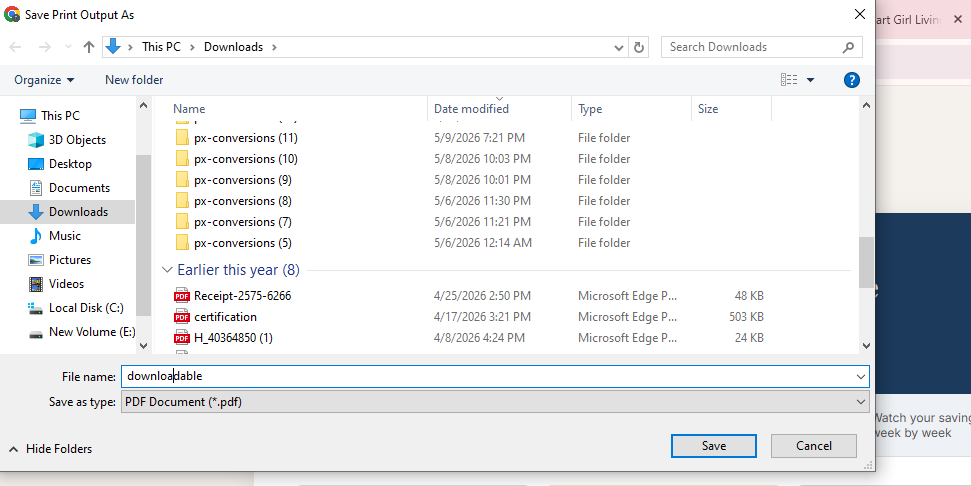
Step 4:
A save dialog will open. Choose your folder, name the file (example: “52-week-challenge-printable”), and click Save. Your PDF is now saved to your computer, ready to print!
Should You Work With a Financial Advisor?
For most everyday financial goals building an emergency fund, paying off debt, saving for a house, setting a budget you don’t need a financial advisor. The framework above covers the essentials, and the resources on this site give you the tools to implement it.
There are situations where working with a financial planner or financial consultant genuinely adds value: significant investment decisions, complex tax situations, estate planning, retirement income strategy, or any situation involving amounts of money where a mistake would have serious long-term consequences.
If you’re in one of those situations, look for a fiduciary financial advisor one who is legally required to act in your interest rather than earning commissions on products they sell you. You can find fiduciary financial advisors near me through the NAPFA directory (napfa.org) or the Garrett Planning Network.
For most people reading this, though, the framework above is what you need. Set the goals, calculate the monthly numbers, automate the system, review monthly.
The One Thing That Separates People Who Reach Financial Goals From Those Who Don’t
It’s not income level. It’s not intelligence. It’s not starting with a lot of money.
It’s writing the goals down and reviewing them regularly.
The research on this is consistent: people who write their goals down and check them monthly are dramatically more likely to achieve them than people who keep goals mentally. There’s something about committing a number and a deadline to paper that changes how seriously you treat it and how often you think about it.
Use the printable. Write the numbers down. Set the monthly reminders. The goals themselves are almost secondary to the habit of taking them seriously.
For a complete budget setup that makes room for your financial goal contributions, my guide on how to make a budget for beginners walks through exactly how to find the monthly amounts and assign them in your budget.
If saving faster is one of your goals, my guide on how to save money fast on a tight budget has 20 specific ways to find extra money in your current spending most of which can fund a goal contribution without changing your lifestyle significantly.
And if paying off debt is one of your financial goals which it is for most people my guide on how to pay off debt fast gives you a complete debt payoff plan you can run alongside your savings goals.